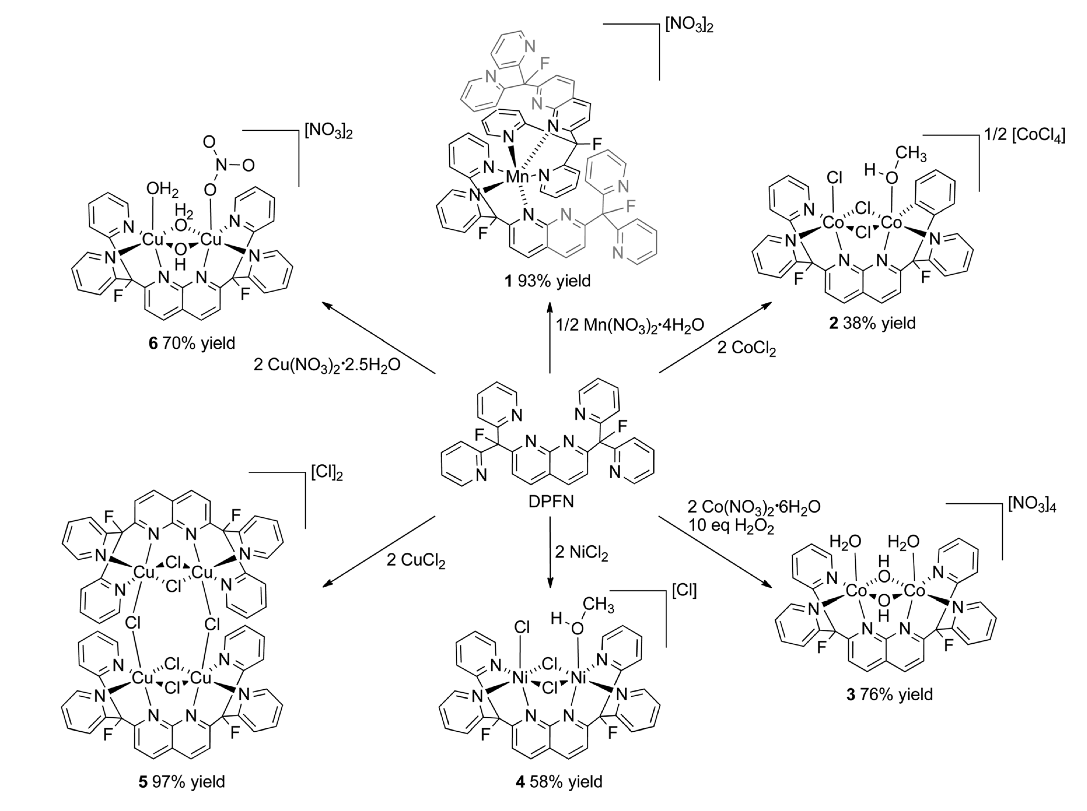
A series of dinuclear and tetranuclear first-row transition metal complexes were synthesized with the dinucleating ligand 2,7-bis(di(2-pyridyl)fluoromethyl)-1,8-naphthyridine (DPFN). The coordination pocket and rigidity of the DPFN ligand enforces pseudo-octahedral geometries about the metal centers that contain chloro, hydroxo, and aqua bridging ligands forming a “diamond” shaped configuration with metal–metal distances varying from 2.7826(5) to 3.2410(11) Å. Each metal center in the dinuclear complexes has an additional open coordination site that accommodates terminal ligands in a syn geometry of particular interest in catalyst design. The complexes are characterized by electronic spectroscopy, electrochemistry and potentiometric titration methods.
Electrochemical evidence that pyranopterin redox chemistry controls the catalysis of YedY, a mononuclear Mo enzyme
Hope Adamson a, Alexandr N. Simonov b, Michelina Kierzek c, Richard A. Rothery c, Joel H. Weiner c, Alan M. Bond b, and Alison Parkin a,1 a Department of Chemistry, University of York, Heslington, York YO10 5DD, United Kingdom; b School of Chemistry, Monash University, Clayton, VIC 3800, Australia; and c Department of Biochemistry, University of Alberta, Edmonton, AB T6G 2H7, Canada Edited by Harry B. Gray, California Institute of Technology, Pasadena, CA, and approved October 13, 2015 (received for review August 25, 2015) http://www.pnas.org/content/112/47/14506.short A long-standing contradiction in the field of mononuclear Mo enzyme research is that small-molecule chemistry on active-site mimic compounds predicts ligand participation in the electron transfer reactions, but biochemical measurements only suggest metal-centered catalytic electron transfer.With the simultaneous measurement of substrate turnover and reversible electron transfer that is provided by Fourier-...

コメント