スキップしてメイン コンテンツに移動

Chiral-at-Metal Phosphorescent Square-Planar Pt(II)-Complexes from an Achiral Organometallic Ligand


Chiral-at-Metal Phosphorescent Square-Planar Pt(II)-Complexes from an Achiral Organometallic Ligand

† Department of Chemistry and Chemical Biology, TU Dortmund University, Otto-Hahn-Straße 6, 44227 Dortmund, Germany
§ Institute for Inorganic Chemistry, Georg-August University Göttingen, Tammannstraße 4, 37077 Göttingen, Germany
‡ Division of Chemistry and Materials Science, Graduate School of Engineering, Nagasaki University, Bunkyo-machi, Nagasaki 852-8521, Japan
⊥ Dipartimento di Medicina Molecolare e Traslazionale, Università di Brescia, Viale Europa 11, 25123 Brescia, Italy
J. Am. Chem. Soc., 2017, 139 (20), pp 6863–6866
DOI: 10.1021/jacs.7b03963
Publication Date (Web): May 8, 2017
Copyright © 2017 American Chemical Society


この論文では、新規有機金属Pt(ll)錯体を合成し、その異性体の同定およびそれらの異性体の選択的な合成に成功しています。

フェニルピリジンを配位子に有する有機金属Pt錯体は、光物理特性を示す化合物として研究が進んでいます。
これらの有機金属錯体は、CH-activationを伴うシクロメタル化または有機リチウム前駆体によるトランスメタル化によって得られます。

またキラル配位子を用いたキラル性をもつ錯体の合成は広く行われていますが、それに対しアキラル配位子を用いたキラル性をもつ錯体の報告例はあまりありません。

そこで本論文では、有機金属C^N供与ができるようなアキラルな配位子を用いて、金属中心がキラル性をもつ新規錯体の合成を試みています。
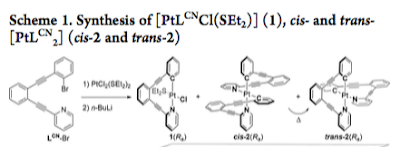


上のScheme 1に示すような3種類の異性体が得られ、これら異性体の同定を1HNMR、単結晶X線結晶構造解析、CDスペクトル、および DFT計算によって行っています。

自分の研究で、有機金属錯体の同定において参考にできると思いました。


コメント

人気の投稿

Electrochemical evidence that pyranopterin redox chemistry controls the catalysis of YedY, a mononuclear Mo enzyme

Hope Adamson a, Alexandr N. Simonov b, Michelina Kierzek c, Richard A. Rothery c, Joel H. Weiner c, Alan M. Bond b, and Alison Parkin a,1 a Department of Chemistry, University of York, Heslington, York YO10 5DD, United Kingdom; b School of Chemistry, Monash University, Clayton, VIC 3800, Australia; and c Department of Biochemistry, University of Alberta, Edmonton, AB T6G 2H7, Canada Edited by Harry B. Gray, California Institute of Technology, Pasadena, CA, and approved October 13, 2015 (received for review August 25, 2015) http://www.pnas.org/content/112/47/14506.short A long-standing contradiction in the field of mononuclear Mo enzyme research is that small-molecule chemistry on active-site mimic compounds predicts ligand participation in the electron transfer reactions, but biochemical measurements only suggest metal-centered catalytic electron transfer.With the simultaneous measurement of substrate turnover and reversible electron transfer that is provided by Fourier-...

Rhenium(V)–oxo corrolazines: isolating redox-active ligand reactivity

Jan Paulo T. Zaragoza,a   Maxime A. Sieglera and   David P. Goldberg* Chem. Commun., 2015, Advance Article DOI: 10.1039/C5CC07956J Received 22 Sep 2015, Accepted 15 Oct 2015 First published online 28 Oct 2015 http://pubs.rsc.org/en/content/articlelanding/2015/cc/c5cc07956j#!divAbstract Abstract The synthesis of the first example of a third-row metallocorrolazine characterized by single crystal X-ray diffraction is reported. This ReV(O) porphyrinoid complex shows an exclusively ligand-based reactivity with strong acids and oxidizing agents. The one-electron oxidized π-radical-cation complex is capable of H-atom abstraction.

Tuning Reactivity and Selectivity in Hydrogen Atom Transfer from Aliphatic C–H Bonds to Alkoxyl Radicals: Role of Structural and Medium Effects

Michela Salamone and Massimo Bietti* Dipartimento di Scienze e Tecnologie Chimiche, Università “Tor Vergata”, Via della Ricerca Scientifica, Italy Acc. Chem. Res., Article ASAP DOI: 10.1021/acs.accounts.5b00348 Publication Date (Web): November 6, 2015 クメンパーオキシドを光で開裂させることにより、生成するクミルアルコキシルラジカルによるアルカンやアミンのC–H切断の速度定数などの情報がまとまっています。 溶媒や、酸、基質の形が反応速度定数に与える影響を定量的に評価しています。 酸化反応をしている方は、手元に置いておいても良いのでしょうか。

C–H Bond Oxidation Catalyzed by an Imine-Based Iron Complex: A Mechanistic Insight

Giorgio Olivo§¶, Martina Nardi§, Diego Vìdal¶, Alessia Barbieri§, Andrea Lapi§‡, Laura Gómez¶⊥, Osvaldo Lanzalunga§‡, Miquel Costas*¶, and Stefano Di Stefano*§‡ § Università degli Studi di Roma, Rome, Italy ¶ Institut de Química Computacional i Catàlisi (IQCC),  Girona, Spain Inorg. Chem., 2015, 54 (21), pp 10141–10152 DOI: 10.1021/acs.inorgchem.5b01500 Publication Date (Web): October 12, 2015 A family of imine-based nonheme iron(II) complexes (LX)2Fe(OTf)2 has been prepared, characterized, and employed as C–H oxidation catalysts. Ligands LX (X = 1, 2, 3, and 4) stand for tridentate imine ligands resulting from spontaneous condensation of 2-pycolyl-amine and 4-substituted-2-picolyl aldehydes. Fast and quantitative formation of the complex occurs just upon mixing aldehyde, amine, and Fe(OTf)2 in a 2:2:1 ratio in acetonitrile solution. The solid-state structures of (L1)2Fe(OTf)(ClO4) and (L3)2Fe(OTf)2 are reported, showing a low-spin octahedral iron center, with the lig...

Oxidative Alkene Cleavage Catalysed by Manganese-Dependent Cupin TM1459 from Thermotoga maritima

van Hajnal 1 , Kurt Faber 1,2 , Helmut Schwab 1,3 , Mélanie Hall 2,* and Kerstin Steiner 1,* a   acib, Austrian Centre of Industrial Biotechnology GmbH, Petersgasse 14, 8010 Graz, Austria Fax: ( + 43)-316-873-9302; phone: ( + 43)-316-873-9346; e-mail: kerstin.steiner@acib.at b   Department of Chemistry, University of Graz, Heinrichstraße 28, 8010 Graz, Austria Fax: ( + 43)-316-380-9840; phone: ( + 43)-316-380-5479; e-mail: melanie.hall@uni-graz.at c   Institute of Molecular Biotechnology, TU Graz, Petersgasse 14, 8010 Graz, Austria Adv .S ynth. Catal. 2015 , 357 , 3 309 –3 316 DOI: 10.1002/adsc.201500608 Abstract A novel biocatalytic oxidative alkene cleavage activity was identified in protein TM1459 from Thermotoga maritima , a so far uncharacterised metalloprotein with a cupin fold, which preferentially binds manganese (over iron and zinc). Various styrene derivat...